
Module 3 – SEMINAR

Origins and Origin Studies: Where does intersectionality come from?
Most often, intersectionality is credited to Crenshaw. However, while Crenshaw in her 1989 article is the first one to coin the term intersectionality, the central idea that is now represented under the sign of “intersectionality” is much older and grounded in decades, if not a century, of activism, creativity, and theorizing, primarily by Black, Indigenous and women of color in North America and beyond. Indeed, the contexts in which Crenshaw invented the term intersectionality were long ongoing debates in the US, Canada, and elsewhere within feminist, anti-racist and other social justice movements about how to account for and theorize what we might call social differences (race, gender, sexuality, class etc.) and multiple forms of oppression.
Intersectionality – Crenshaw’s Metaphor
After having introduced the intersection metaphor in 1989, Crenshaw expanded on it two years later in a 1991 article titled “Mapping the Margins: Intersectionality, Identity Politics, and Violence against Women of Color”:
My objective there was to illustrate that many of the experiences Black women face are not subsumed within the traditional boundaries of race or gender discrimination as these boundaries are currently understood, and that the intersection of racism and sexism factors into Black women’s lives in ways that cannot be captured wholly by looking at the race or gender dimensions of those experiences separately. (Crenshaw 1991, 1244)
Crenshaw’s point here is while Black women sometimes encounter discrimination similar to the sexism experienced by white women and sometimes resembling the racism Black men face, at other times, Black women’s discrimination is unique. Black women’s discrimination can not simply be reduced to a “double discrimination” of sexism plus racism. Crenshaw’s observations may seem straightforward yet it is profound. Acknowledging the experiences of Black women as unique and in their own right appears logical, yet critical legal studies, including Crenshaw’s work, demonstrate that the law and other institutions often fail to treat Black women on such terms. Instead, the very case studies that led to the coining of the term, demonstrate the erasure of Black women’s discrimination in a single-axis categorical lens that privileges one form of domination (such as racism or sexism or classism) and assumes all members of a particular group share identical experiences along that single axis.
Such a “single-axis” approach tends to equate racism and sexism as parallel rather than intersecting or co-constitutive modes of power. By contrast, intersectionality and Black feminist thought consider racism and sexism as dynamically intertwined in perpetuating inequality. Another way to think about this is to consider that the sexist discrimination Black women face takes racialized forms. And that racism takes a specific sexist forms. To mind here come racist stereotypes wielded against Black women as hypersexual. It is impossible to pry apart which part of this stereotype is racist and which part is sexist. Instead, racism takes a sexist gender-specific form here, and sexism shapes a particular form of gendered racism.
The idea of intersectionality did not emerge out of nowhere. While the term intersectionality is rightly attributed to Crenshaw, lively discussions about, for example, anti-racism, multiculturalism, social differences, and multi-vector analysis shaped feminism not only in the US but also in Canada, Europe, and other parts of the world throughout the latter part of the 20th century, in scholarly, activist, and creative feminist and BIPoC communities (not that these are mutually exclusive terms).
Early Articulations of Intersectional Thought
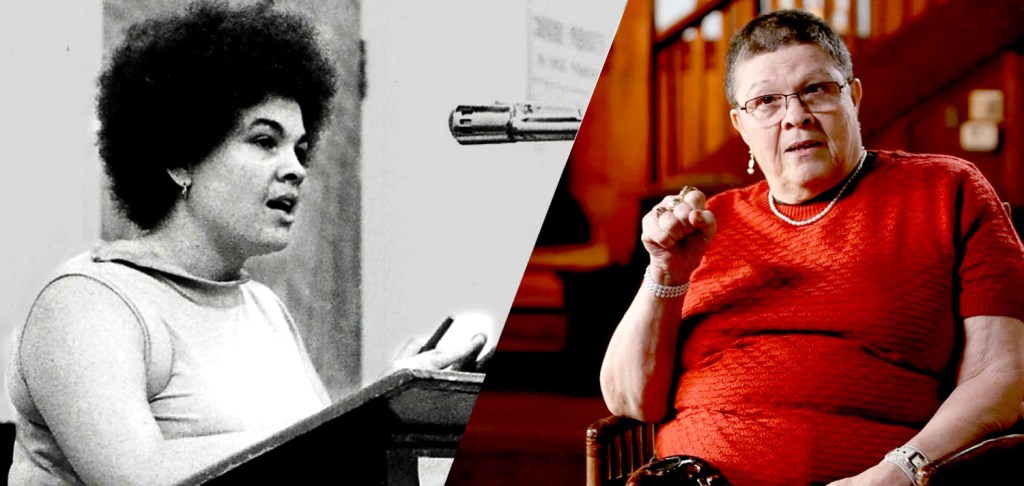
Francis Beal, feminist peace and social justice activist
Earlier articulations tried to conceptualize the dynamic and co-constituting ways multiple forms of domination work together. For example, 30 years prior to Crenshaw, the Black feminist and peace and social justice activist Francis Beal, then active in the Student Non-Violent Coordinating Committee, wrote in a widely circulating text about the Double Jeopardy: To Be Black and Female. Written in 1969, the text was distributed as a pamphlet by The Third World’s Women’s Alliance between 1970 and 1975.
In this activist text, Beal analyses the specific systemic oppression of Black women in America under the dual forces of racism and capitalism, highlighting their economic exploitation. She calls out Black men for embracing (white) sexist misconceptions projected onto Black women and argues for Black women’s liberation alongside Black men.
The economic system of capitalism finds it expedient to reduce women to a state of enslavement. They oftentimes [sic] serve as a scapegoat for the evils of this system. Much in the same way that the poor white cracker of the South who is equally victimized, looks down upon blacks and contributes to the oppression of blacks, –So by giving to men a false feeling of superiority (at least in their own home or in their relationships with women,) the oppression of women acts as an escape valve for capitalism. Men may be cruelly exploited and subjected to all sorts of dehumanizing tactics on the part of the ruling class, but they have someone who is below them – –at least they’re not women. …the exploitation of black people and women works to everyone’s disadvantage and … the liberation of these two groups is a stepping stone to the liberation of all oppressed people in this country and around the world. (Beale 1969, n.p., emphasis added)

Interestingly enough, Beal cites another text that is often regarded as one of the earliest articulations of what we now call intersectionality: the famous “Ain’t I a Woman” speech by the abolitionist and women’s rights activist known as Sojourner Truth, at the Women’s Rights Convention in Akron, Ohio in 1851.
Her speech, based on her lived experience as a formerly enslaved woman, is commonly understood as challenging the sexist construction of women as naturally weak while also challenging the racist construction of enslaved women as not-women by repeatedly asking the question, “ain’t I a woman”?
Sojourner Truth’s story is often positioned as a powerful illustration of what intersectionality is about and as paradigmatic of the connection between inequalities based on racism and sexism and the importance of thinking about these different forms of inequality in relation to one another (Crenshaw 1989; Brah and Phoenix 2004; May 2012).

For example, the African American feminist theorist and essayist bell hooks, titled her 1981 book Ain’t I a Woman: Black Women and Feminism. In this foundational work, hooks offered an early Black feminist critique of the ways (white) feminist theory had ignored Black women’s experiences as the grounds for theorizing.
Rather than seeing racism and sexism as separate processes—the dominant conceptualization both historically and at the time of writing the book, hooks (1981) insists that they were intertwined and lived together (13). However, hooks (1981), different from Sojourner Truth’s speech, in titling her book is not posing a question mark after “Ain’t I a Woman.” Without this question mark, hooks is stating rather than inquiring about Black women’s womanhood in relation to feminism and asserts Black women’s rightful position within feminist movements.
Sojourner Truth as Symbol
However, the African American historian Neil Painter, in her (1997) book Sojourner Truth: A Life, A Symbol, contends that Truth never uttered the famous phrase “Ain’t I a Woman?” Rather, the speech’s version widely circulating today in feminist textbooks and historical ‘reenactments’ was recorded twelve years after the 1851 convention by the white abolitionist Frances Dana Gage. For rhetorical effect, Gage embellished the speech with a southern dialect and speech patterns that Truth as a Northerner would not have used. Gage reportedly added the now famous phrase “Ain’t I a woman?”
In her 2023 lecture, Painter offers a more detailed analysis of Sojourner Truth that is well worth watching (optional)
“Sojourner Truth Was A New Yorker, and She Didn’t Say That” with Nell Irvin Painter, 2023
Rather than representing an accurate historical record, we need to read Sojourner Truth as a powerful symbol that is invoked and mobilized very differently for varying political purposes at different historical junctures: In the 19th century, amidst the efforts to end slavery, Sojourner Truth was seen as proof of the potential for harmony between Black and white people, with abolitionists portraying her as a peaceful Christian appreciating white efforts and feminists emphasizing her role bridging Black and women’s rights causes. Today, for many, Sojourner Truth figures as a powerful representation of strong Black womanhood historically, during and in the aftermath of slavery, and as a forerunner for 20th century intersectional thought.
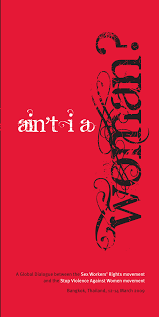
Today, “Ain’t I a woman?” is widely invoked by a range of political activist groups and for a number of different causes around the world. If you google the phrase you will note, it’s the theme for a global dialogue on sex workers’s rights (2009); the title of the African American Transgender artist and actress Laverne Cox’s (2015) performance tour, and the name of a London collective that centers “the voice of women with African ancestry.” These are just a few examples. And, of course, there is a T-shirt.
ACTIVITY:
Search the internet for other examples and contexts that invoke the “Ain’t I a woman” call. Analyze how that phrase is mobilized in that specific context. What do you notice?
Other texts considered precursors to the coining of intersectionality as a concept include the 1977 statement by the Combahee River Collective, which is part of the assigned readings for this Module. The Combahee River Collective (C.R.C.) introduced the concept of the “interlocking system of oppression” when analyzing the simultaneous working of racism, sexism, heterosexism and classism in their lives.
The African-American feminist poet Audre Lorde in her (1984) essay “Age, Race, Class, and Sex: Women Redefining Difference,” drew attention to the political and personal costs of ignoring the complexity of overlapping – or what we now call intersectional – identities. Writing in the context of the women’s movement at the time, Lorde calls out white women who “focus upon their oppression as women and ignore differences of race, sexual preference, class and age” (116).
In 1988, Deborah K. King in her classic essay “Multiple Jeopardy, Multiple Consciousness: The Context of a Black feminist Ideology” asserts that “interactive oppressions that circumscribe our lives provide a distinctive context for black womanhood” (42). King traces this insight into “the double jeopardy” that Black women face, back a century to Anna Julia Cooper. Cooper, a former slave and later educator, had written in the late 1800s of “the double enslavement” as Black women, who ”’confronted … both a woman question and a race problem” (Cooper cited in King 1988: 42). King in her 1988 text, challenges the premise that “each discrimination has a single, direct and independent effect on status, wherein the relative contribution of each is readily apparent” (47). She also rejects “non-productive assertions that one factor can and should supplant the other” (47).
This is all to say that Crenshaw in 1989 did not develop the notion of intersectionality single-handedly. Instead, what we today call intersectionality builds upon at least a century of Black feminist thought and a diverse community of feminists of color, lesbians, Jewish, working class, and white activists and writers who grappled with how to think and organize around the complexity that social differences and multiple forms of oppression make.
The Problem of Origin Stories
How we tell the story of the origin of intersectionality matters. But telling stories about intersectionality’s origins is much trickier than this Module can account for. Much like other histories, origin stories rarely just tell us about the past “as it really was.” Instead, a turn to the past usually works through the eyes and needs of the present. Meaning that origin stories and histories of origins make demands on the present. In the case of “recounting” the origin of intersectionality as a term, a theory, lens, and a politics, this demand is about giving credit to the intellectual and activist work of those who developed these ideas and analyses. Giving credit for ideas is also described as “the ethics of citation.”
Beyond crediting intellectual and activist labor, especially the labor of those whose voices are often ignored or written out of history, giving credit also raises a the thorny question of “ownership,” as in who has intellectual and political rights to intersectionality, and to what end should intersectionality or should not be applied. We already addressed this a bit earlier. This includes concerns about mainstreaming of intersectionality and whether intersectionality is always and only about marginalized people or also useful for studying the intersections of privilege. This is an extensive and contested debate.
Hancock (2016) offers the thought provoking suggestion that we “walk away from a debate grounded in consumerist terms like ‘ownership’ and instead think in terms of stewardship” (22), which for her entails “the notion of an interpretive community being entrusted with the care of such a precious and complicated phenomenon like intersectionality” (23).
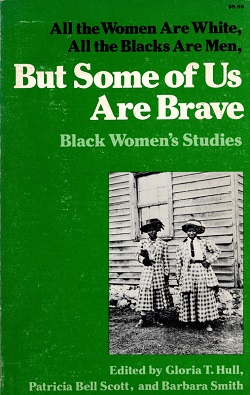
An ethics of citation means acknowledging Crenshaw and the century of Black feminist thought gestured towards in this Module. And keeping in mind and crediting the broader intellectual and political context in which Crenshaw coined this term, which includes a broad collective multicultural alliance of not only Black, but also Indigenous, multicultural, and antiracist feminists and queers at the time. This also means that there are many more texts beyond those mentioned here that were influential.
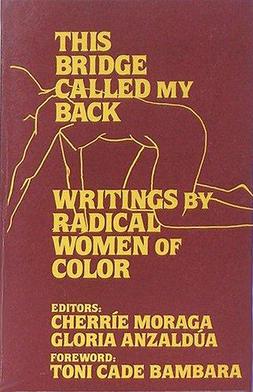
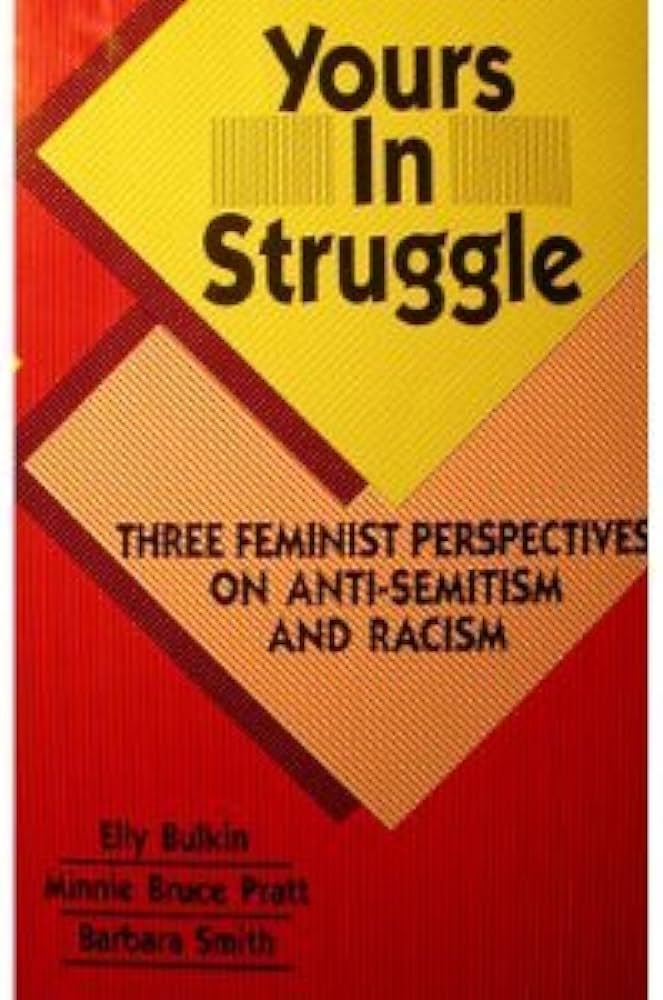
Examples of influential essay collections from the 1980s that grappled with various intersections of oppression.
REFLECT:
Take a moment to consider what “stewardship for intersectionality” might mean? What ethical consideration does the notion of stewardship invoke, especially in light of what some have called the appropriation and the “whitening of intersectionality” (Bilge 2013)?
The Ethics and Politics of Citation
The question of ‘where does intersectionality come from?’ invites us to consider our own citational practices, both when referencing intersectionality specifically but also the work we draw upon in our research. “Citational practices … offer a way to mark collectivity, delineate historical precedence, and claim legacies of struggle,” suggests Vivian May (2015, 55).
Most of you will be well aware of the ethics of citation as a way to avoid being accused of plagiarism. But beyond being a principle of academic honesty and crediting intellectual labour, who we cite matters. Our citations show whose voice, insight, and scholarship we see as authoritative. And being frequently cited, in turn establishes one’s authority in academic and activist contexts. Thus, citations are political and carry significant political implications. The selection of who we cite has the potential to perpetuate existing inequalities within our academic fields and society at large. Our citations can confirm and reinforce already existing racist, sexist, colonial and heteronormative knowledge hierarchies or serve as a means to challenge and rectify existing inequalities. Given that citations are inherently political, the decision to not cite someone else’s work holds equal weight. Omissions in citations are as meaningful as the citations themselves.
Sara Ahmed (2013) makes the ethics of citations also very concrete when describing the tendency in academia, even among feminists, to cite primarily male theorists, who in turn come to represent scholarly authority within and as “the discipline.” According to Ahmed, citations are “a rather successful reproductive technology, a way of reproducing the world around certain bodies.” Depending on the field, citations thus tend to reproduce the world according to the views of male, white, able-bodied, middle to upper-class settler academics.
WATCH

(Playing time 2:53)
In this video clinical psychologist and founder of the Intersectionality Training Institute, Dr. Lisa Bowleg, speaks further to the issues of citing Black women when speaking about intersectionality.
WATCH
(Playing time 9:14)
In this clip taken from the May 17, 2025 Intersectionality Research Salon, hosted by the Intersectionality Training Institute on “#CiteBlackWomen” Elizabeth Cole, a leading Intersectionality scholar, asked members of the “Cite Black Women Collective” to expand on the meaning of the term “politics of citation” and “genealogy of knowledge”. In response, Yasmiyn Irizarry, PhD, Daisy E. Guzman Nunez, PhD, and Whitney Pirtle, PhD. expand on the range of harmful effects of established academic citational practices.
While you watch, jot down the different kind of harms the speakers address.
The question we want to grapple with is in this course is how to produce intersectional citational practices.

ACTIVITY:
Take a moment to reflect. For example, look at course outlines from your current courses (Gender Studies, related fields, or any other subject). What do you notice about citational practices? Check the bibliographies/ reference lists of papers and projects you have undertaken over the recent year. What do you notice about your own citational practices? Who do you cite and why?



 UNIVERSITY OF ALBERTA WGS 498/GSJ 598