Module 3 – Critical Skills
Working with Sources – Summarizing, Paraphrasing, Quoting
Before we dig into the material for this module, I suggest you take a refresher on how in academic work, we integrate the work of others into our own work. Depending on how closely you work with a source, these are the three ways we use in academic writing:
Quotations require replicating the exact words of the original source and attributing them to the original author, while paraphrasing entails rephrasing a passage using one’s own language and crediting the source. Summaries involve condensing the main points of a text into one’s own words, also acknowledging the original source.
Using quotations, paraphrases, and summaries serves multiple purposes. In academic writing, we use them to:
- Provide evidence to support arguments or enhance the credibility of our writing.
- Reference previous work that contributes to our current research.
- Present diverse perspectives on a topic by incorporating examples.
- Highlight positions we either agree or disagree with.
- Emphasize notable phrases, sentences, or passages from the original source through direct quoting.
- Indicate that certain words are not our own by quoting them, thereby creating distance from the original source.
- Enrich the breadth or depth of our writing by integrating different forms of textual representation.
Experienced writers tend to weave summaries, paraphrases, and quotations together.
Summarizing
In the previous module, we discussed active reading strategies, emphasizing the importance of initially scanning an article to understand its structure. We suggested that after this, skimming and focusing on each paragraph’s introduction, topic sentences, and conclusions are key steps. Balancing between reading quickly and slowing down for closer examination is crucial. Additionally, it’s essential to keep your reading goals in mind—are you seeking an overview of a topic or specific ideas for a project? Are you analyzing a text’s contribution to a discussion or its analytical approach? Your objectives should guide your reading strategies accordingly.
Texts that encompass a wide range of materials, including academic and non-academic texts, fiction, non-fiction, films, and audio-visual materials, typically present arguments. Sometimes these arguments are stated explicitly, while other times, they may be less obvious and only implied. Identifying the main argument or point in a text is a valuable strategy. Articulating a text’s purpose or intervention in your own words is a crucial academic skill. It’s worthwhile to invest time in identifying the following aspects of each text you encounter in your research.
- When was this written, by whom, and who is the intended audience?
- What is the main argument or point of the text – where is it?
- How is the argument supported? (What evidence or smaller arguments, critiques etc. are mobilized to make the argument? What does the author endorse, and what do they critique?)
- What are new important concepts and key terms introduced in this text? (Tip: Creating a glossary of key terms and definitions can be extremely productive for your research project. Don’t forget to include complete references for your source.)
- Also helpful is to jot down a short summary or precis of each text.
All of these steps help you to summarize a text or video and to articulate the main idea(s) or argument(s) in a concise one or two-sentence paragraph that you need for the literature review section of your project (term, paper, article, grant application, thesis, dissertation, or similar).
Paraphrasing
Beyond summarizing whole texts in a literature review, paraphrasing is probably the most utilized strategy in academic writing. Paraphrasing involves objectively representing the ideas and information from a source in your own words while maintaining the original meaning of a text passage or film segment. The purpose of paraphrasing is to restate information or ideas from a source in a manner that is clearer, more concise and reflects your understanding. This allows for effective integration of sources into your writing while avoiding plagiarism.

WATCH
Watch this introductory video to refresh your familiarity with the art of paraphrasing.
Quoting
Watch this introductory video to refresh your familiarity with the art of quoting.
Newcomers to academic writing often tend towards over-quoting. Over-quoting, which refers to the excessive use of quotations in a text, thereby overshadowing the writer’s own words. Importantly, quotations rarely stand alone but rather necessitate the writer to provide context, explanation, or critique.
Under-referencing refers to writers including ideas, words, arguments taken from somewhere etc. that are not their own without providing proper references. This risks being charged with plagiarism, which is a serious academic offence. Plagiarism is not just an issue for students but also for all academics and other professionals, for whom plagiarism can have devastating consequences.
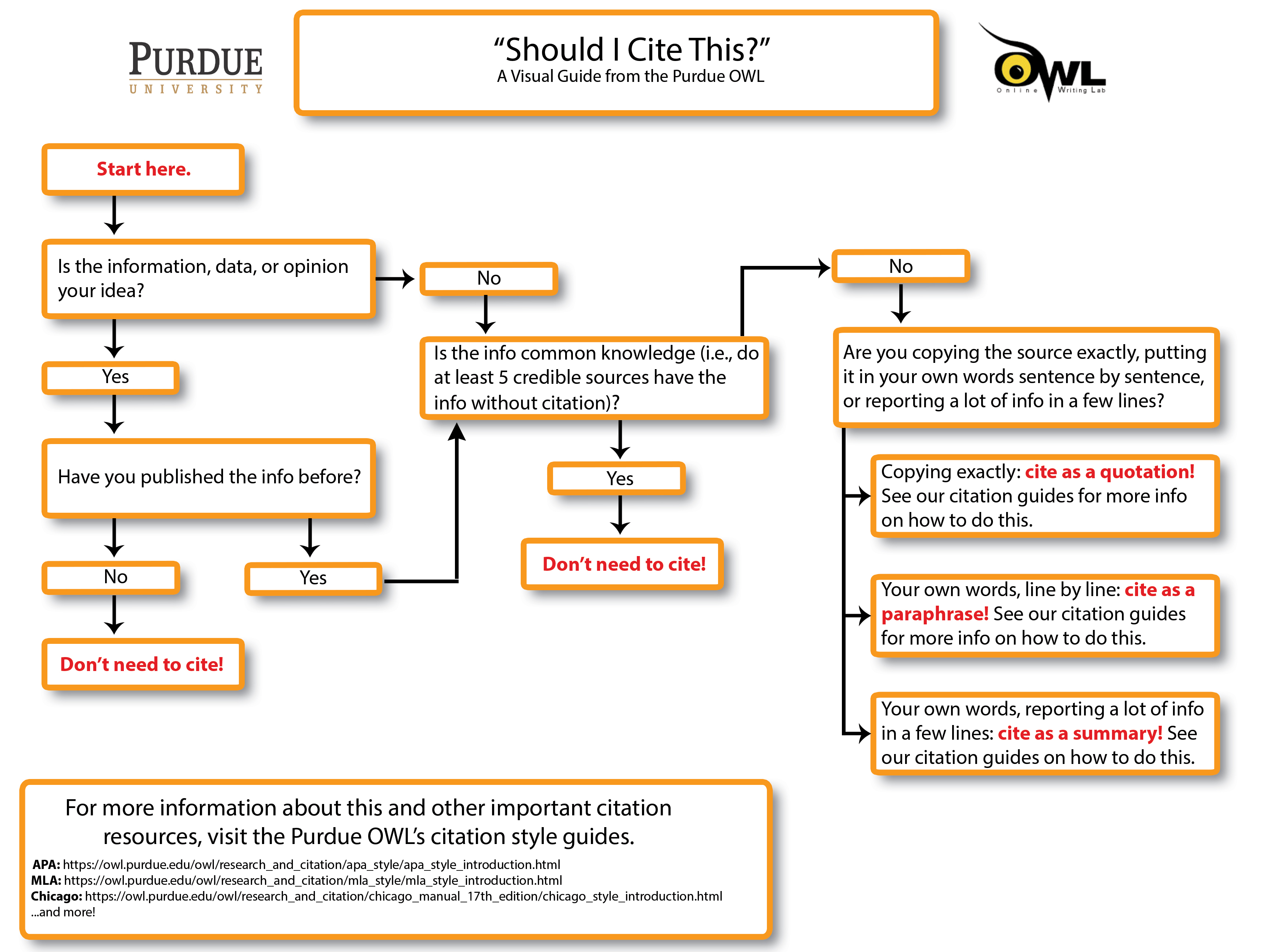
If you’re unsure whether a citation or reference is needed for the information included in your work, Purdue University’s Owl Online Writing Lab offers an excellent decision chart to guide you.
Should I Cite This?


Reflect:
Take a moment to reflect on your academic writing to assess your proficiency in integrating others’ work into your own using summaries, paraphrases, and quotations. Identify areas of strength and areas needing improvement.
What other resources have you found helpful in the past? What further resources are you able to locate?



 UNIVERSITY OF ALBERTA WGS 498/GSJ 598